How carbon works in a gold plant
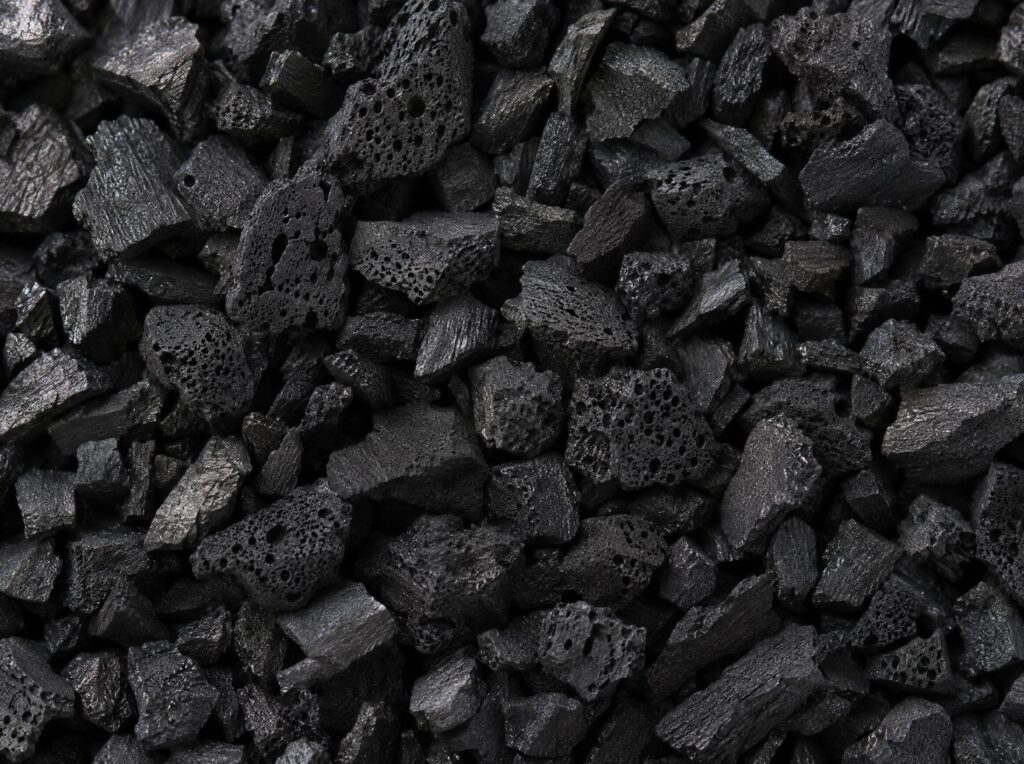
Gold mines use activated carbon to capture dissolved gold from cyanide leach solutions. We supply hard, coconut shell based granules made for this job, matched to your circuit and your specification.
Where it works
Carbon-in-pulp (CIP)
Granules are mixed into the leached slurry in a series of tanks, take up the gold, and are screened out and moved from tank to tank against the flow.
Carbon-in-leach (CIL)
Leaching and gold capture happen in the same tanks, which saves a separate leach stage.
Carbon-in-column (CIC)
For heap leach and other clear solutions, which flow up through columns of carbon.
Elution and reactivation
The loaded carbon is stripped with a hot caustic cyanide solution (the AARL or Zadra method), the gold is recovered by electrowinning, and the carbon is acid washed and reactivated in a kiln for reuse.
Typical specification buyers ask for
Raw material
Coconut shell, for high hardness and a fine pore structure
Particle size
6x12 mesh (3.35 to 1.70 mm) or 8x16 mesh (2.36 to 1.18 mm)
Hardness (ASTM D3802)
97 to 99% minimum, so granules survive agitation, pumping and screening
Iodine number (ASTM D4607)
About 900 to 1,100 mg/g
CTC activity (ASTM D5742)
50 to 65%
Ash and moisture
Ash 3 to 5% maximum, moisture 5% maximum
These are typical industry ranges, not a guarantee for a specific product. Ask us for the technical data sheet of the grade we quote, and compare it with your own specification.
To quote, tell us: your circuit (CIP, CIL or CIC), mesh size, minimum hardness and activity, monthly volume, packaging, and destination port.
Get a gold recovery carbon quote